





 Wednesday, 25-11-26









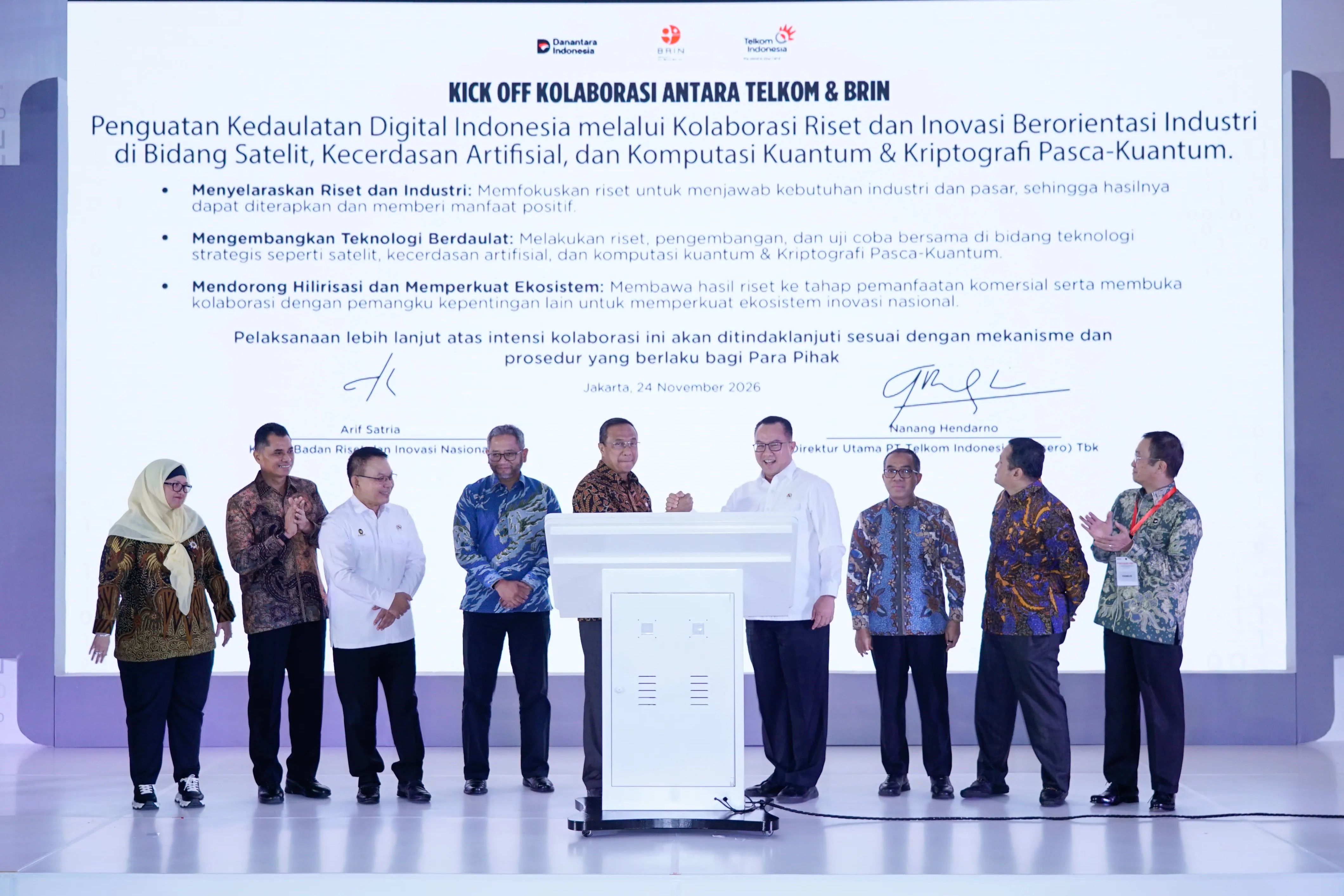
PT Telkom Indonesia (Persero) Tbk (Telkom) and Indonesia's National Research and Innovation Agency (BRIN) have agreed to collaborate on research and innovation in satellite technology, artificial intelligence (AI), and quantum computing to strengthen Indonesia's digital sovereignty (24/11).
The collaboration was signed in Jakarta by BRIN Head Arif Satria and Telkom President Director Nanang Hendarno. It focuses on connecting BRIN's research activities with market needs and bringing the resulting innovations to commercial markets through TelkomGroup.
The partnership adopts a joint innovation-to-commercialization approach, directing research toward industry requirements from the beginning. Its aim is to ensure that research outcomes can move beyond laboratories and be applied to provide practical benefits.
Telkom and BRIN Strengthen Indonesia's Digital Sovereignty Through Research Collaboration
The collaboration has three main objectives: aligning research with industry and market needs, developing sovereign technologies through joint research and testing, and accelerating the commercialization of research outcomes.
The agreement covers three strategic technology areas: satellite technology, artificial intelligence, and quantum computing, including Post-Quantum Cryptography (PQC).
Telkom President Director Nanang Hendarno said that digital sovereignty requires more than adopting existing technologies. He emphasized the importance of developing technological capabilities independently.
"Digital sovereignty cannot be built simply by adopting technology; it also requires the ability to develop it independently. Indonesia has strong research capabilities at BRIN, and Telkom wants to ensure that these research outcomes are connected to market needs, so they can become products used by industries and society," Nanang said.
BRIN Head Arif Satria said the agency has research talent, scientific expertise, and infrastructure to support the collaboration. These resources include high-performance computing (HPC) facilities for artificial intelligence, machine learning (ML), and big data, as well as satellite infrastructure.
"BRIN has talent, research capabilities, and infrastructure, ranging from HPC facilities for AI, ML, and Big Data to satellite infrastructure. Through collaboration with Telkom, these research outcomes can be tested directly by users and the market, allowing industries and society to benefit from them more quickly," Arif said.
AI Development Focuses on Indonesian-Language Models and Industry Applications
In artificial intelligence, Telkom and BRIN will develop Indonesian-language Large Language Models (LLMs) and Small Language Models (SLMs) through the ModelHub platform.
The collaboration also includes four priority AI use cases involving Danantara Indonesia, MIND ID, Pertamina, and Garuda Indonesia.
In addition, the two organizations will develop AI models based on BRIN's research expertise in several scientific fields, including agriculture, fisheries, healthcare, and mining.
These initiatives are part of the collaboration's focus on developing AI research that is aligned with industry requirements.
Satellite Cooperation Covers GEO Services and National LEO Development
In the satellite technology sector, Telkom and BRIN plan to introduce satellite imagery services and develop portable, affordable user terminals for Geostationary Earth Orbit (GEO) satellites.
In the longer term, the cooperation will gradually focus on developing a national Low Earth Orbit (LEO) satellite constellation.
One of its planned functions is Positioning, Navigation, and Timing (PNT). The collaboration will also cover mapping and navigation applications based on satellite data.
The satellite initiatives will involve TelkomGroup's capabilities, including the participation of its subsidiary Telkomsat in the satellite technology domain.
Quantum Computing Collaboration Includes Post-Quantum Cryptography
In quantum computing, Telkom and BRIN will develop Post-Quantum Cryptography (PQC) solutions for digital signatures, Internet of Things (IoT) devices, and Virtual Private Networks (VPNs).
PQC for digital signatures has also been identified as one of the three priority initiatives under the collaboration.
The other two quick-win initiatives are Ground Station as a Service (GSaaS) and Indonesian-language LLMs and SLMs.
Telkom and BRIN Prioritize Three Quick-Win Initiatives
The three quick-win initiatives are intended to support the early implementation of the collaboration while establishing a foundation for the development of national strategic technologies.
Telkom will be responsible for bringing BRIN's research outcomes to the market. Its role will include customer validation, joint product development, and preparation for go-to-market activities.
"Telkom will play a role in bringing BRIN's research outcomes to the market, starting with customer validation and joint product development through to go-to-market readiness. Through several quick-win initiatives, we want the initial results of this collaboration to be felt as soon as possible, while building a long-term foundation for national strategic technologies," Nanang said.
Under the agreement, BRIN will contribute research capabilities, scientific expertise, and research infrastructure. TelkomGroup will align research activities with market requirements and support the commercialization of the resulting innovations.
The collaboration is also open to other stakeholders who wish to contribute to strengthening Indonesia's national innovation ecosystem.
PHOTO: TELKOM INDONESIA
This article was created with AI assistance.
We make every effort to ensure the accuracy of our content, some information may be incorrect or outdated. Please let us know of any corrections at [email protected].
Read More