





 Tuesday, 24-11-26









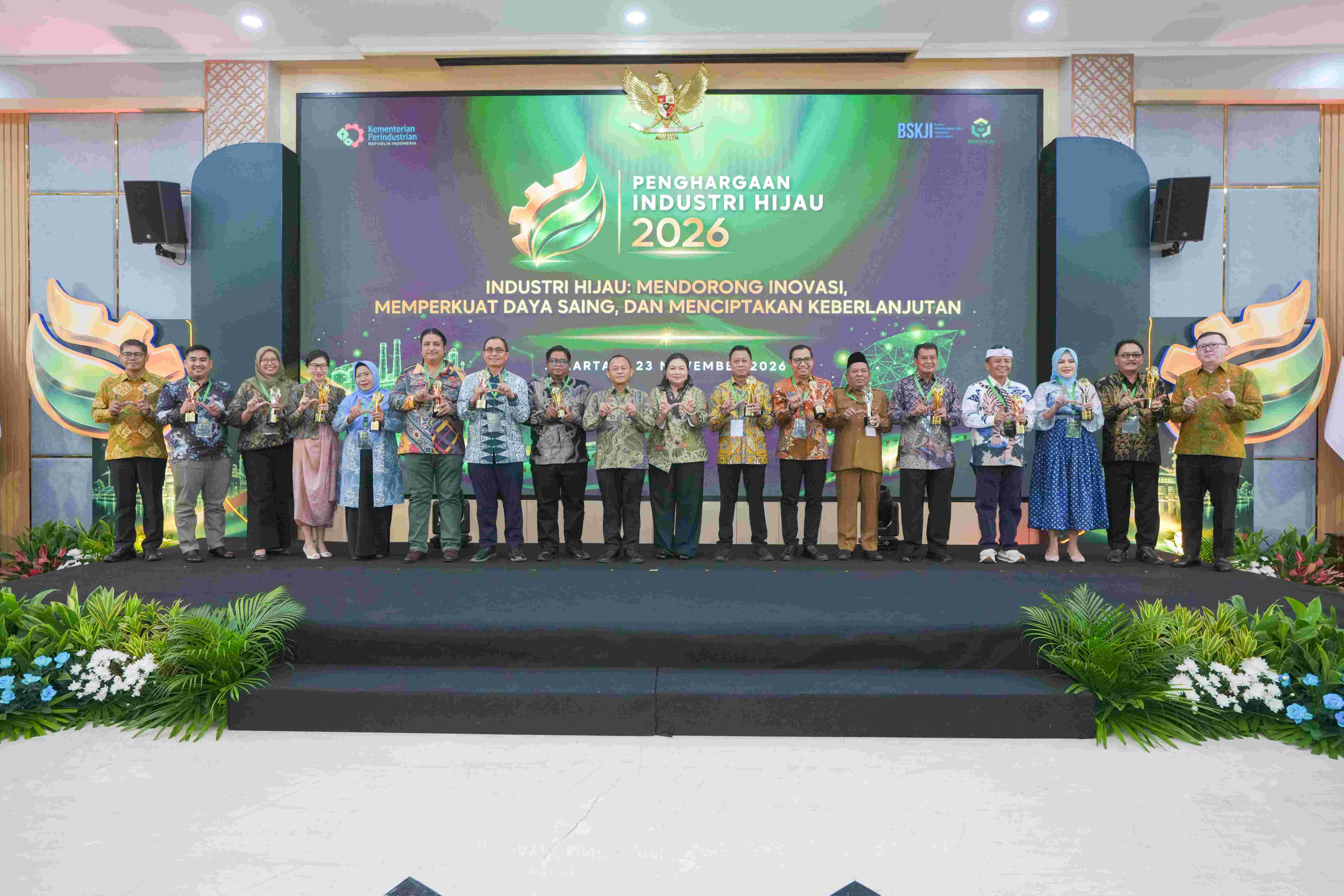
Indonesia's green industry transformation has generated annual energy savings of 1,755 gigawatt-hours (GWh), worth approximately Rp1.75 trillion, among companies recognised in the Transformation Towards Green Industry category at the Green Industry Awards 2026 in Jakarta (23/11).
The participating companies also recorded annual water savings of 960,000 cubic metres, equivalent to approximately Rp8.6 billion. The achievements were presented by Minister of Industry Muhammad Sarmuji during the awards ceremony.
"These achievements demonstrate that implementing green industry practices delivers tangible and measurable benefits. I hope these awards will motivate all industry players and regional governments to continue strengthening innovation and expanding green industry practices," Sarmuji said.
Green Industry Transformation Generates Economic and Environmental Benefits
The benefits of green industrial practices also extend to social and environmental programmes. In the Best Green Industry Performance category, corporate social and environmental responsibility programmes generated Rp22.33 billion in benefits from a total investment of Rp8.4 billion.
The figure was calculated using the social return on investment (SROI) method.
Sarmuji said green industry had become a strategic necessity for the sustainability and competitiveness of Indonesia's industrial sector. Growing global awareness of environmental issues has encouraged markets to prioritise environmentally friendly products and production processes.
"Global public awareness of environmental issues is growing. Industries must begin adapting because otherwise their markets could be threatened. Environmental responsibility can now become an additional strength for industries to improve their competitiveness," he said.
He added that green industrial transformation should no longer be considered an additional burden but an opportunity to increase added value and strengthen Indonesia's position in global competition.
Sarmuji also cited developments in the global automotive industry, where manufacturers are increasingly prioritising low-emission vehicles. During a working visit to China, he observed that environmental concerns had become part of automotive companies' strategies for innovation and international market competition.
He said sustainability commitments were also an important part of Indonesia's Golden Indonesia 2045 vision, which aims to create a sovereign, advanced and sustainable nation.
According to Sarmuji, industrial development should not focus only on short-term economic growth but must also protect natural resources for future generations.
He emphasised that green industrial transformation should progress alongside the expansion of Indonesia's manufacturing sector.
"Continued manufacturing growth needs to be balanced with improvements in resource efficiency, technological innovation, workforce productivity and the implementation of low-carbon production processes," he said.
Indonesia Implements Four Strategies for Industrial Decarbonisation
The Ministry of Industry has established four strategies to support national emissions reduction targets and encourage green industrial transformation.
The first strategy focuses on decarbonisation across nine priority industrial subsectors through the preparation of roadmaps and mitigation measures.
The second promotes a circular economy across eight priority subsectors by optimising the use of materials and resources.
The third involves implementing green industry standards to improve energy, water and material efficiency while reducing emissions. As of 2026, the Ministry of Industry has established 72 Green Industry Standards, supported by 24 certification bodies and 172 active green industry certificates.
The fourth strategy focuses on green technology, including carbon capture and utilisation (CCU), which converts carbon from industrial processes into products with economic value.
"We want CCU technology to be adopted more widely across the industrial sector. This technology can not only help reduce carbon emissions but also generate additional economic value, including through soda ash production, which Indonesia still imports in significant quantities," Sarmuji explained.
According to the minister, CCU technology development has entered the pilot stage and has the potential to be expanded to other industries, including steel manufacturing. The ministry will continue introducing the technology to more companies.
Sarmuji also highlighted the importance of circular economy practices, which involve reusing resources and materials throughout production processes to reduce waste and improve efficiency.
"A circular economy must become a shared vision. Resources used in production processes must be utilised repeatedly. If possible, we should even achieve zero waste," he said.
Green Industry Awards 2026 Recognise Companies and Regional Governments
Head of the Industrial Services Standardisation and Policy Agency (BSKJI), Emmy Suryandari, said the awards recognise sustainability achievements while encouraging companies and regional governments to improve their environmental performance.
"Successful industrial decarbonisation cannot be measured solely by stated commitments, but by concrete actions and measurable emissions reductions," Emmy said.
The Green Industry Awards 2026 recognised companies and regional governments in several categories.
In the Transformation Towards Green Industry category, the recipients were PT Pacific Medan Industri, PT Chandra Asri Pacific, PT Oleochem & Soap Industri, and PT Eka Ormed Indonesia.
The Best Green Industry Performance category recognised PT Asia Pacific Rayon, PT Sarihusada Generasi Mahardhika – Prambanan Factory, PT Torabika Eka Semesta, and Rezti's Batik.
For provincial governments, the recognised institutions were the East Java Provincial Industry and Trade Office, the Central Java Provincial Industry and Trade Office, and the West Java Provincial Industry and Trade Office.
At the regency and municipal levels, the recipients were the Tangerang Regency Industry and Trade Office, the Jombang Regency Trade and Industry Office, and the Madiun City Manpower, Cooperatives, Small and Medium Enterprises Office.
Regional governments also play an important role in expanding green industrial practices. Assistance and empowerment programmes have reached 557 medium and large industries and 460 small and medium industries.
Award-Winning Companies Report Emissions and Resource Savings
Eviyanti Tarigan, Management Representative Lead at PT Pacific Medan Industri, said winning first place in the Transformation Towards Green Industry category had motivated the company to continue improving its environmental performance.
The company, which processes palm cooking oil and its derivative products, has implemented greenhouse gas emissions management and various innovations to improve production efficiency.
"This award is both a starting point and a challenge for us to continue improving corporate performance towards a greener industry," Eviyanti said.
Meanwhile, Lastiani Rosalina, Factory Director of PT Sarihusada Generasi Mahardhika – Prambanan Factory, said the company secured second place in the Best Green Industry Performance category.
Through various efficiency measures and innovations, the factory reduced carbon emissions by 96 per cent, lowered energy consumption by 28 per cent and achieved water savings of 26 per cent.
"We view the utilisation of cleaner energy as one of the important steps in the transformation towards a green industry," Lastiani said.
The Green Industry Awards 2026 programme also includes an industrial exhibition held from 23 to 26 November 2026 at the Ministry of Industry's Industrial Plaza in Jakarta. The exhibition involves 11 participants from regional governments and companies.
The programme also features a discussion forum titled "Decarbonisation in the Industrial Sector", bringing together government representatives, industry players, technology providers, research institutions and development partners.
PHOTO: MINISTRY OF INDUSTRY
This article was created with AI assistance.
We make every effort to ensure the accuracy of our content, some information may be incorrect or outdated. Please let us know of any corrections at [email protected].
Read More