





 Tuesday, 24-11-26









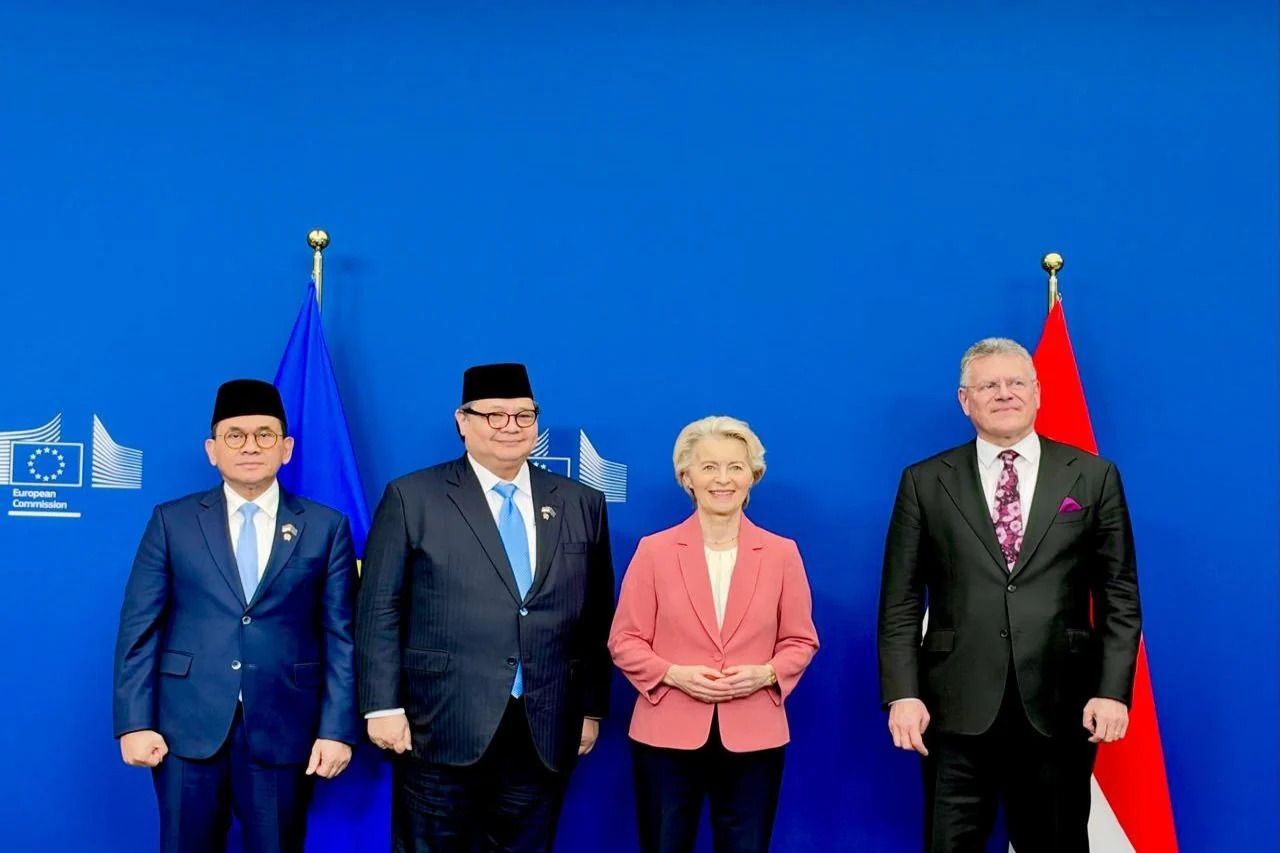
After nearly a decade of intensive diplomatic negotiations, Indonesia and the European Union officially signed the Indonesia European Union Comprehensive Economic Partnership Agreement in Brussels, Belgium, on November 21, 2026. This landmark bilateral treaty links Southeast Asia's largest economy, home to approximately 280 million citizens, with the world's largest single market comprising 27 European member states and 450 million consumers. Together, this newly integrated economic corridor represents an unprecedented market access zone serving 730 million people. Overseen by Indonesia's Coordinating Minister for Economic Affairs Airlangga Hartarto and European Commissioner for Trade and Economic Security Maros Sefcovic, the formal signing ceremony marks a pivotal shift in global commerce. By dismantling long standing tariff barriers and harmonizing regulatory frameworks, the agreement establishes a resilient, rules based foundation designed to accelerate bilateral trade, stimulate foreign direct investment, and insulate both regions from global supply chain disruptions.
The Strategic Scope Of The Comprehensive Economic Partnership Agreement
To appreciate the scale of this diplomatic milestone, it is essential to look at the macroeconomic weight of both signatories. Across its 27 member states, the European Union commands a combined Gross Domestic Product of 19.4 trillion US dollars, offering Indonesian exporters direct entry into one of the most affluent consumer bases on the planet. Conversely, Indonesia offers European enterprises privileged access to the fourth most populous nation in the world and the undisputed economic powerhouse of the Association of Southeast Asian Nations.
European Commission President Ursula von der Leyen described the Comprehensive Economic Partnership Agreement as one of the most ambitious trade deals the European bloc has ever concluded in Asia. Unlike traditional free trade deals that focus strictly on customs duties, this modern Comprehensive Economic Partnership Agreement encompasses goods, services, public procurement, intellectual property rights, digital commerce, and sustainable development. Furthermore, both parties simultaneously executed a companion Investment Protection Agreement to ensure that cross border capital flows enjoy maximum legal certainty and transparent dispute resolution mechanisms.
Tariff Elimination Breakdown And Bilateral Trade Data
The immediate commercial impact of the Comprehensive Economic Partnership Agreement centers on sweeping tariff liberalization. Prior to this accord, total annual bilateral trade in goods and services between Indonesia and the European Union stood at roughly 32 billion US dollars, with 2025 trade recorded at 28.9 billion euros or approximately 31.7 billion US dollars. In the first nine months of 2026 alone, bilateral goods trade reached 26.08 billion US dollars, demonstrating a strong 11.64 percent year over year expansion even before the treaty took effect.
Once the Comprehensive Economic Partnership Agreement enters into force, 90.4 percent of all European Union tariff lines for Indonesian export products will immediately drop to zero percent. An additional 8.37 percent of tariff lines will undergo gradual duty reductions over a transition period spanning three to fifteen years, or will be managed through specialized Tariff Rate Quotas for sensitive agricultural goods. Only a tiny fraction of sensitive products will remain outside the liberalization schedule.
On the reciprocal side, Indonesia has committed to eliminating import duties on up to 98.5 percent of European export tariff lines once full implementation is achieved. According to economic impact assessments published by Brussels, this aggressive tariff removal will save European businesses more than 600 million euros, or roughly 658 million US dollars, in customs duties every single year. Over the next 15 years, European exports to Indonesia are projected to grow by nearly 40 percent, creating substantial momentum for bilateral industrial integration.
Macroeconomic Growth And Key Sectoral Winners
Long term economic modeling conducted ahead of the November 2026 signing indicates substantial Gross Domestic Product expansion for both regions. By 2042, the European Union's economy is projected to be 16 billion euros larger than it would be without the accord, while Indonesia's Gross Domestic Product is forecasted to gain an additional 27 billion euros. Indonesian Minister of Trade Budi Santoso has also set an ambitious medium term target to boost national exports to the European Union by 50 percent within the first five years of implementation.
Several labor intensive and resource based Indonesian industries are positioned to capture immediate market share gains under the zero tariff regime:
- Footwear and Leather Goods: Indonesian footwear manufacturers, who have historically faced stiff tariff disadvantages compared to regional competitors like Vietnam, will gain immediate duty free access. Exports in this sector are projected to surge by 652 million euros.
- Textiles and Apparel: Garment and textile producers stand to gain the largest single volume increase, with apparel exports forecasted to expand by 779 million euros as European fashion retailers diversify their sourcing networks.
- Palm Oil and Agricultural Derivatives: Despite years of heated debate surrounding environmental standards and deforestation regulations, the treaty includes a dedicated protocol on palm oil and regulatory cooperation. Exports of vegetable oils and processed agricultural goods are projected to grow by 512 million euros through structured Tariff Rate Quotas and sustainability frameworks.
- Fisheries and Processed Foods: Marine products and processed commodities will enjoy reduced entry costs across European ports, strengthening rural coastal economies across the Indonesian archipelago.
- Geographical Indications: The treaty grants formal legal protection across all 27 European member states for 72 unique Indonesian Geographical Indications, safeguarding specialty regional coffees, spices, and artisanal products from counterfeit branding.
Accelerating Foreign Direct Investment And Industrial Downstream Goals
Beyond merchandise trade, the Comprehensive Economic Partnership Agreement operates in tandem with the newly signed Investment Protection Agreement to catalyze high value capital inflows. Data compiled by the Indonesian Cabinet Secretariat reveals that European Union foreign direct investment into Indonesia totaled 14.8 billion US dollars between 2021 and 2026, with cumulative five year capital flows reaching roughly 25 billion US dollars. Historically, these investments concentrated heavily in chemical manufacturing, pharmaceuticals, food processing, and power generation.
With enhanced legal protections and predictable regulatory standards now locked in, Jakarta is actively courting European capital for its flagship industrial downstreaming agenda. Indonesian officials confirmed during the Brussels press briefings that the agreement respects Indonesia's sovereign right to process raw minerals domestically. Instead of exporting unprocessed ores, Indonesia is inviting European automakers, chemical conglomerates, and engineering firms to build local electric vehicle battery ecosystems, semiconductor fabrication plants, and renewable energy infrastructure. Additionally, the elimination of Indonesian import duties on European precision machinery will allow domestic factories to upgrade their production lines with advanced European manufacturing technology at significantly lower capital expenditure.
Navigating The January 2027 Implementation Deadline
While the November 21 signing ceremony represents a monumental diplomatic triumph, both governments face a strict legislative deadline to ensure a seamless commercial transition. Under European Union trade regulations, Indonesia's current preferential market access through the standard Generalised Scheme of Preferences is scheduled to expire permanently on December 31, 2026. In 2025, Indonesian exports entering Europe under this preferential scheme totaled 6.2 billion euros, or approximately 6.8 billion US dollars, making Indonesia the second largest beneficiary globally behind India.
If the Comprehensive Economic Partnership Agreement is not ratified or provisionally applied by January 1, 2027, Indonesian exporters would suddenly face standard Most Favored Nation customs tariffs, erasing their competitive margins overnight. Consequently, Coordinating Minister Airlangga Hartarto emphasized that Jakarta is working closely with the House of Representatives to expedite domestic ratification, while the European Parliament prepares for accelerated plenary deliberations in December 2026. Meeting the first quarter 2027 operational target will ensure uninterrupted market access for thousands of exporters and small enterprises across both continents.
Strengthening Digital Trade And Small Business Integration
To ensure that economic gains are distributed broadly rather than concentrated solely among multinational conglomerates, the Comprehensive Economic Partnership Agreement incorporates modern provisions for digital commerce and Micro, Small, and Medium Enterprises. The treaty establishes clear rules governing cross border data flows, electronic authentication, and consumer privacy, while strictly prohibiting forced transfers of proprietary software source code as a condition for market entry.
For smaller businesses, navigating complex European Union sanitary, phytosanitary, and technical product standards has long been a major barrier to entry. The agreement introduces streamlined customs procedures, including self certification of origin mechanisms, alongside dedicated bilateral committees that provide technical assistance to help smaller Indonesian producers meet European compliance benchmarks. By lowering administrative friction and connecting 730 million consumers under a unified, predictable framework, the Comprehensive Economic Partnership Agreement lays the foundation for decades of shared prosperity between Indonesia and Europe.
Read More