


 Friday, 30-10-26


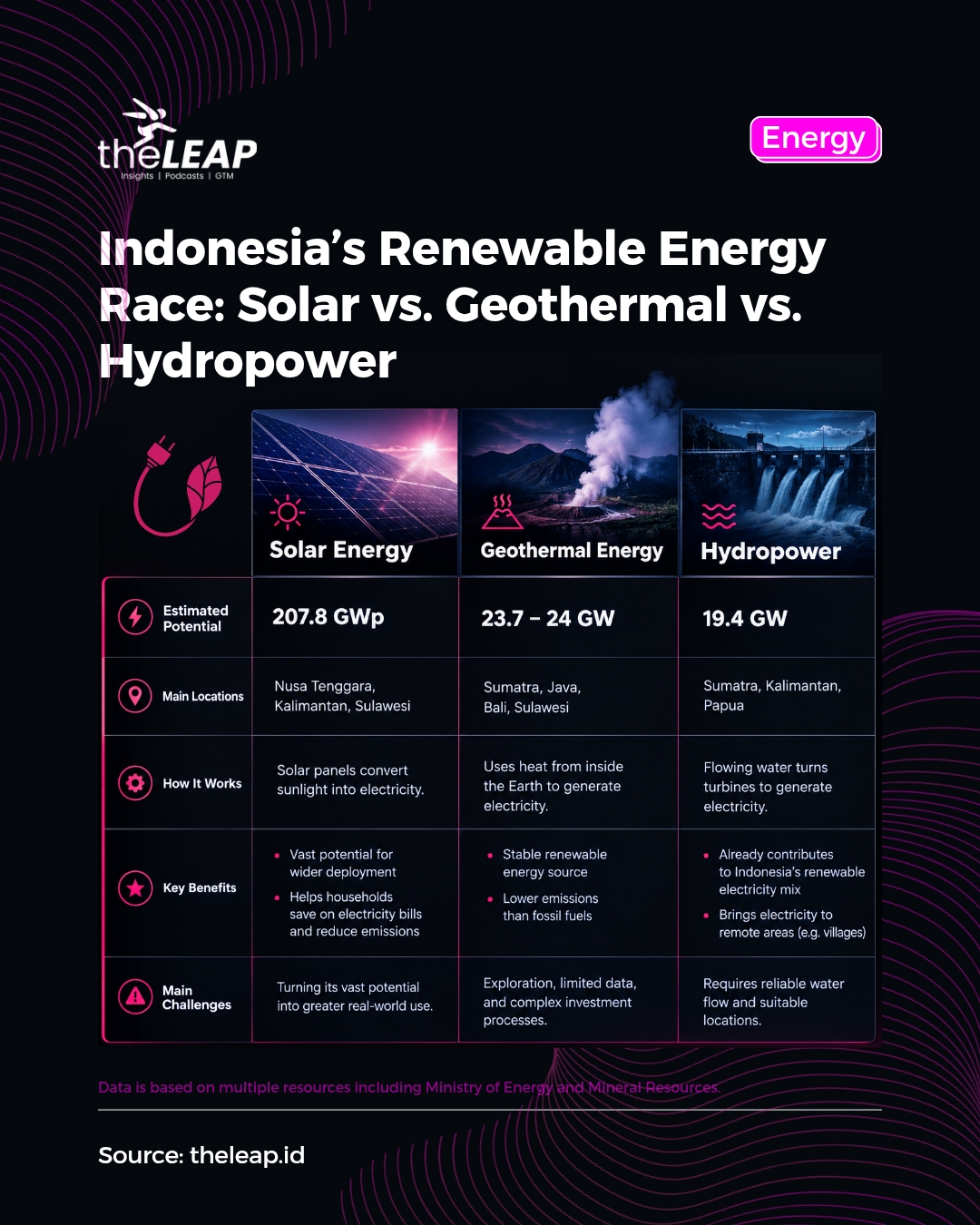
Indonesia has significant renewable energy potential from solar, geothermal and hydropower, but much of this potential remains underdeveloped, according to studies and government data provided by the sources.
The three energy sources offer different opportunities, from expanding solar power installations to developing geothermal resources and using flowing water to generate electricity.
Indonesia’s Renewable Energy Potential
Indonesia’s total renewable energy potential is estimated at 7,879.4 gigawatts (GW) under Scenario 1 and 6,811.3 GW under Scenario 2, according to a study released by the Institute for Essential Services Reform (IESR) in October 2021.
The study, titled Beyond 443 GW: Indonesia’s Infinite Renewable Energy Potentials, used Geographic Information Systems (GIS) to map the technical potential of renewable energy across Indonesia.
Solar power accounted for the largest share of the potential identified in the study, at 7,714.6 GW under Scenario 1 and 6,749.3 GW under Scenario 2. Other resources included micro-hydropower, with estimates of 28.1 GW and 6.3 GW under the two scenarios, respectively, and biomass power, with an estimated potential of 30.73 GW.
The estimated potential of individual energy sources varies across the materials provided. The figures below follow the specific sources cited for each type of energy.
Solar Energy Offers Potential for Wider Development
Indonesia has an estimated solar energy potential of 207.8 gigawatts-peak (GWp), according to the overview published by Telkom University. Its main potential areas include Nusa Tenggara, Kalimantan and Sulawesi.
Solar power plants use panels to convert sunlight into electricity. An inverter then converts the direct current (DC) produced by the panels into alternating current (AC).
Solar power systems can operate off-grid, on-grid or as hybrid systems. Off-grid systems are not connected to other electricity generation systems and require batteries to store energy.
Rooftop solar installations also offer opportunities to expand solar power use. According to the provided information, Indonesia has an estimated rooftop solar potential of 32.5 GW, with households accounting for 19.8 GW, businesses 5.9 GW, social facilities 4.6 GW, industry 1.9 GW and government facilities 0.3 GW.
As of the end of 2023, Indonesia had 8,941 rooftop solar customers with a combined capacity of 149 megawatts-peak (MWp). Most were residential customers, with West Java recording the largest number, followed by Jakarta, Central Java and Yogyakarta.
Rooftop solar can reduce land requirements, help customers save on electricity bills and reduce greenhouse gas emissions.
Geothermal Energy Has Significant Untapped Resources
Indonesia has geothermal potential of 23,742 megawatts (MW), according to the Ministry of Energy and Mineral Resources (ESDM) on 17 September 2025 (17/09). At the time, Indonesia had an installed geothermal electricity capacity of 2,744 MW, making it the world’s second-largest geothermal electricity producer after the United States, which had 3,937 MW.
A separate report from Gadjah Mada University (UGM), published on 4 October 2024, cited geothermal potential of 23,965.5 MW, equivalent to around 40% of the world’s geothermal potential (04/10). The report stated that geothermal energy use remained at around 11% of Indonesia’s total potential.
Geothermal resources are found across Sumatra, Java, Bali and Sulawesi. Geothermal power plants use heat from inside the Earth, including heat carried by water and steam, to generate electricity.
According to the UGM report, geothermal energy produces lower levels of carbon dioxide, sulfur dioxide, nitrogen oxides and solid particles than other energy sources. Its stable power generation is also supported by natural water cycles and the reinjection of extracted fluids into geothermal reservoirs.
However, geothermal development requires more accurate exploration data and improved technology. The government has also sought to simplify regulations and accelerate development through Genesis, a digital platform for geothermal management launched in 2024.
At the 2025 Indonesia International Geothermal Convention & Exhibition, seven memorandums of understanding were signed for education, capacity building and commercial cooperation. These included technology investment and financing commitments covering 265 MW of capacity, with total investment of US$1.5 billion (17/09).
Hydropower Generates Electricity and Supports Remote Communities
Indonesia has an estimated hydropower potential of 19,385 MW, with key resources in Sumatra, Kalimantan and Papua, according to the provided Coaction Indonesia material. Installed hydropower capacity reached 6,699 MW by 2022, making it the largest contributor to Indonesia’s renewable energy mix at that time.
Hydropower plants use the energy of moving water to turn turbines, which drive generators to produce electricity. Their output depends on the height and speed of the water, as well as the amount of water flowing through the system.
Hydropower systems range from pico-hydro plants producing around 5 kilowatts (kW) to micro-hydro plants producing 5–100 kW. Mini-hydro plants generate more than 100 kW but less than 1 MW, while large hydropower plants can produce more than 100 MW.
Micro-hydro projects can also provide electricity to remote villages that lack access to reliable electricity from the state-owned electricity company PLN.
One example is the 37 kW micro-hydro plant built in Mbakuhau, Kamanggih Village, East Sumba, in 2011. The plant supplies electricity to around 100 homes and public facilities, including a community health center, a police office, a school and telecommunications base stations.
The project was developed with support from the Institute for Business and Economic Democracy (IBEKA) and local residents. The plant was later managed by the Jasa Peduli Kasih Cooperative, which reached an agreement with PLN to sell electricity at Rp475 per kilowatt-hour (kWh).
The project also supported the expansion of a 5-kilometer electricity network, provided free electricity registration for 110 residents and led to two plant operators being recruited by PLN. When water flow is too low for the plant to operate, PLN can activate an additional generator.
Infrastructure and Investment Support Renewable Energy Development
Indonesia’s renewable energy development plans also include improvements to electricity transmission infrastructure. In September 2025, the government outlined plans under the 2025–2034 Electricity Supply Business Plan (RUPTL) to build 48,000 circuit kilometers of transmission lines to support electricity system development (17/09).
The government has also sought to accelerate geothermal development by simplifying regulations and organizing geothermal working-area auctions through the Genesis platform.
These measures form part of the development efforts described in the provided sources, alongside investment and cooperation in renewable energy technology.
This article is a summary of two original articles. The full versions can be read at the following links:
https://beee.telkomuniversity.ac.id/potensi-energi-terbarukan-di-indonesia/
https://renewableenergy.id/energi-surya/
https://ugm.ac.id/id/berita/pemanfaatan-energi-geothermal-masih-11-ini-tanggapan-pakar-geologi-ugm/
https://renewableenergy.id/energi-air/
This article was created with AI assistance.
We make every effort to ensure the accuracy of our content, some information may be incorrect or outdated. Please let us know of any corrections at [email protected].
Read More