





 Wednesday, 29-07-26








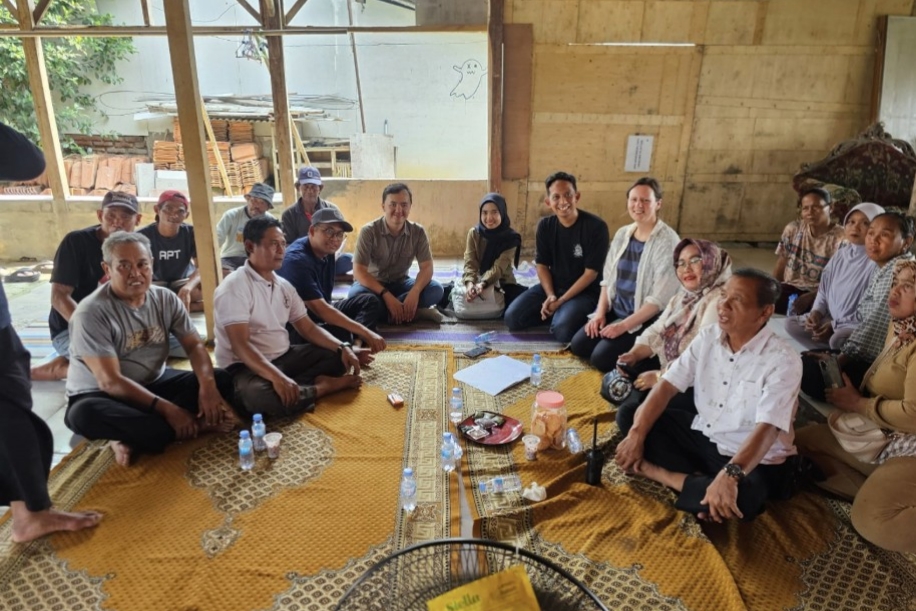
Institut Teknologi Bandung (ITB) is strengthening collaboration among farmers to support the development of climate-smart rice farming that is more resilient and adaptive to climate change through a community service program involving multiple stakeholders (28/07).
The program, titled Building Collective Technology: Strengthening Farmer Institutional Capacity for the Co-Development of Climate-Smart Agricultural Technology, brought together farmers, agricultural extension officers, government representatives, a technology startup, and international academics.
The initiative was conducted from February to July 2026 with the Banyu Asih III, Banyu Sakti I, and Banyu Sakti II farmer groups in Plawad Village, East Karawang District, Karawang Regency. It also involved PT Tani Bersama Estate (TBE), field agricultural extension officers, and the West Java Provincial Food Crops and Horticulture Office.
Karawang, one of Indonesia's major rice-producing regions, faces challenges including climate change, declining soil quality, intensive use of chemical inputs, and uncertain water availability. According to the program, these issues cannot be solved by individual farmers because water management, pests, weeds, and environmental conditions are interconnected across farmland.
ITB Promotes Collective Technology Development
Dr. Angga Dwiartama, head of the program and lecturer at the Resource Management Research Group, School of Life Sciences and Technology (SITH) ITB, said agricultural technology should be developed through collaboration with farmers rather than by introducing new innovations alone.
"Technology will not create change by itself. Technology must be placed in the right context, developed together with farmers, and supported by institutions that enable them to make collective decisions," he said.
Irrigation Improvement Becomes the First Collective Action
Based on field visits, social mapping, and discussions with farmers, the ITB team identified irrigation channels as one of the main issues requiring immediate attention. Cleaning and repairing the irrigation system became the first activity to strengthen cooperation among farmers.
Farmers participated in identifying priority locations, dividing responsibilities, and carrying out the work together. The activity also demonstrated that agricultural management requires coordination beyond individual land ownership.
Sudrajat, deputy head of the Banyu Asih III farmer group, said discussions are an important part of irrigation management.
"Whenever there is a water-related problem, we sit together and discuss the schedule for water use and the timing of community work," he said.
Agricultural Extension Officers Connect Farmers and Technology
The program positioned agricultural extension officers as the main link between farmers and other stakeholders.
Besides providing technical assistance, they strengthened communication among farmer groups, government institutions, academics, and technology providers.
According to the ITB team, the role of extension officers is becoming increasingly important as agriculture adopts data-based technologies such as artificial intelligence, drones, sensors, and digital recommendation systems.
These technologies still require facilitators who can adapt technical information to field conditions and farmers' knowledge.
International Academics Join Farmer Discussions
The program also involved two academics from Wageningen University & Research in the Netherlands, who discussed smallholder agriculture, farmer institutions, agrarian change, and the relationship between technology and rural communities with local farmers.
According to ITB, the discussions were designed as a two-way learning process in which farmers were recognized as partners with knowledge, local innovation, networks, and a deep understanding of their farming environment.
"Community service is a two-way learning process. As academics, we should not see farmers as blank sheets of paper. They have knowledge, experience, bargaining power, and innovations that should become part of technology development," Angga said.
PT Tani Bersama Estate, one of the program partners, introduced a precision and regenerative agriculture approach through the use of local microorganisms, crop monitoring with drones and artificial intelligence, financing support, and market access.
The ITB team stated that the application of modern technology on relatively small and scattered farmland still requires coordination among farmers. Data collected through drones and sensors can provide optimal benefits only when farmers make collective decisions.
PHOTO: ITB
This article was created with AI assistance.
We make every effort to ensure the accuracy of our content, some information may be incorrect or outdated. Please let us know of any corrections at [email protected].
Read More